How to buy a Diamond
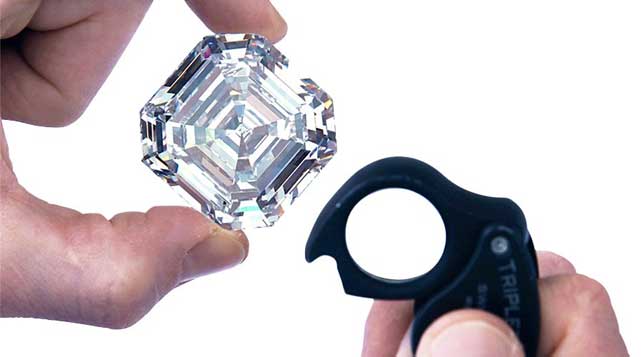
Buying a quality diamond starts with 3Cs, not 4. Surprising? Cut, clarity and color determine the fundamental characteristics of the diamond, but not the carat, because after all, the size of the diamond does not affect its quality. So to best buy your diamond you have to base it on the 3Cs, but also on the fluorescence and the shape.
The quality of a diamond depends both on the raw material, i.e. nature, and on human ability and therefore on what cutters and polishers choose to do with the diamond. Nature creates rough diamonds of different colors and with different inclusions. Man cuts the rough and chooses which of the 4Cs (Cut, color, clarity and carat weight) to favor. The question that often arises is whether the cutter, to best carry out his work, should give priority to the size of the stone he is working on, trying to keep it as large as possible, or whether to obtain a highly transparent stone, eliminate most of the inclusions by sacrificing its size? Therefore, of the 4Cs, only the cut, color and clarity determine the quality of the diamond. The weight, i.e. the carats, does not. A tiny diamond can be as beautiful and well-crafted as a much larger diamond. And finally, of the 4Cs, only the cut is completely under man's control.
What is Diamond Shape Quality?
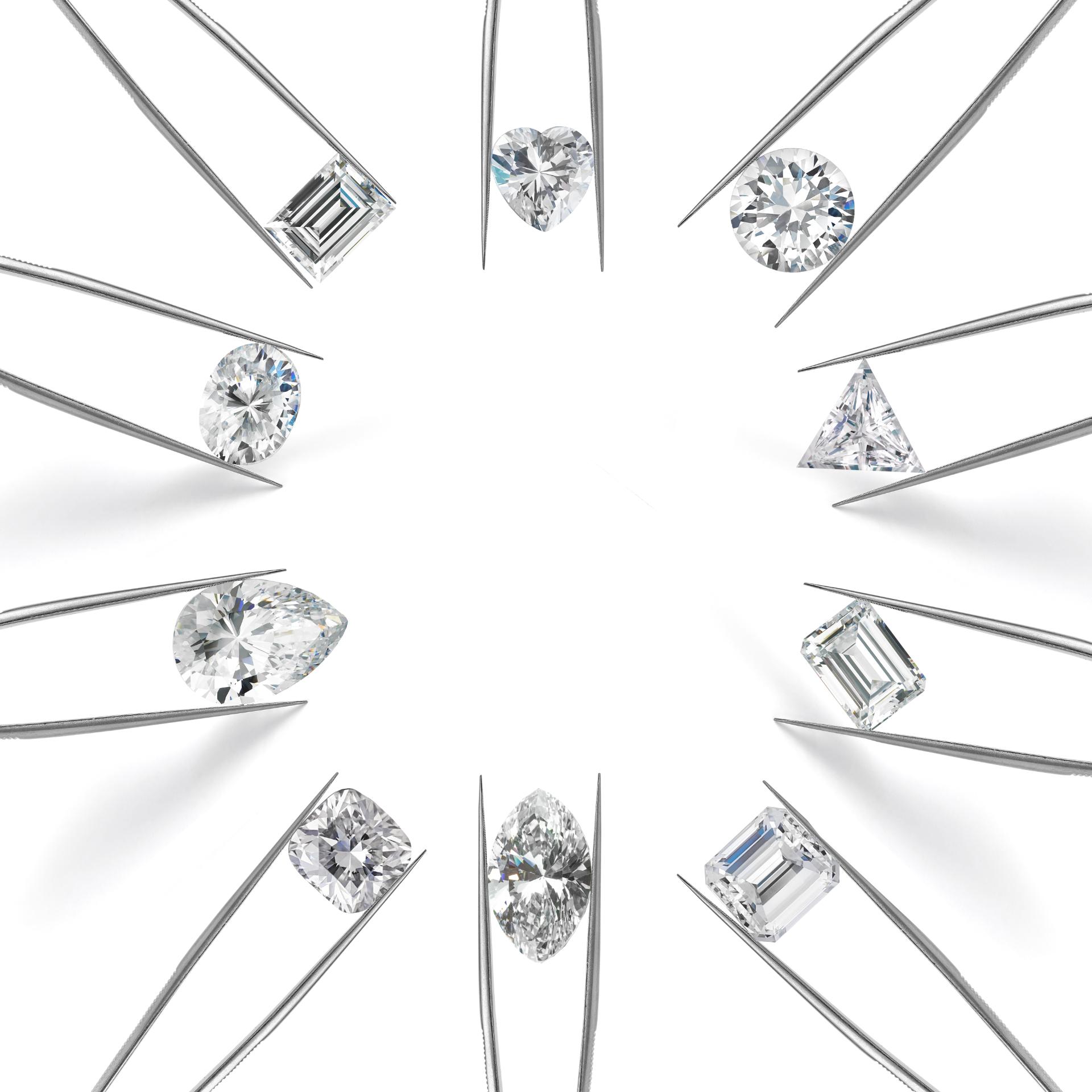
It’s easy to assess the shape quality of brilliant-cut diamonds. Brilliant-cut diamonds should be… well, round! Most brilliant-cut diamonds, especially those with excellent or very good cut grades, are very round, or at least so round that no variation can be detected with the naked eye.
Fancy-cut diamonds are a little more complicated. They don’t receive cut grades from GIA because there are such a wide variety of shapes and cutting styles, each with their own length-to-width ratios and set of standards. Personal preference also plays a role.
Here are 4 things to look for in fancy-shape diamonds:
1. Length-to-width ratio: The L-W ratio is the ratio of the length to the width of a fancy shape, with the width being the number one. Most people find some ratios more attractive than others. For example, emerald cuts, rectangular cushion cuts, and pears are most popular in L/W ratios between “1.50 / 1” and “1.75 / 1.” L/W ratios are also important because gems that are too long and narrow tend to break.
2. Line Symmetry: For hearts and pears, the outline of the diamond should be the same on both sides when you draw a line down the center. For ovals, squares, rectangular, and marquise cuts, the outline of the diamond should be the same on each side vertically and horizontally. Symmetry makes a diamond look crisp and clean and helps maximize a diamond’s brilliance. The grading report for a fancy cut diamond does not contain a cut grade, but it does indicate the stone’s symmetry and polish.
3. Smooth Curves: Curved shapes like hearts, pears, and ovals should have full, rounded “lobes” or “shoulders.” Curves should flow smoothly and have no hard-looking flat spots.
4. Defined shape: It should be obvious what shape a diamond is. A heart, for example, should have a defined slit and a pointed opposite point. The attractiveness of a diamond shape can sometimes depend on the ratio. An oval with too low a length-to-width ratio may look like an irregular round.
What is diamond cut quality?
Cut quality refers to how a diamond's proportions, design, and finish work together to create a beautiful diamond. Proportion refers to the angles and relative size of a diamond's facets. Design refers to a diamond's weight ratio (a diamond can be too heavy or too light for its diameter) and durability (the risk of damage due to thin, vulnerable areas). Finish consists of two factors: polish (the quality and cleanliness of the facet surfaces) and symmetry (the arrangement and placement of the facets). Together, these factors reflect the quality of workmanship that goes into cutting a diamond. Cut quality is important because it affects the way a diamond interacts with light, which determines a diamond's brilliance, fire, and sparkle.
What are brilliance, fire, and sparkle and why are they important?
In short, brilliance is the white light that a diamond reflects off its facets. Fire is the spectrum of color that is seen when a diamond breaks down white light. Finally, sparkle is the alternating light and dark areas that are seen when the diamond moves. These are the three factors that help the diamond put on a great light show.
Brilliant cut diamonds can receive cut grades, while fancy cut diamonds cannot.
Regardless of whether your diamond is cut graded or not, here’s how to check your diamond for cut quality factors:
- Check your diamond’s brightness and sparkle under diffused (white) light. Does your diamond reflect a lot of white light (brightness)? Does it flash a lot when you turn it from side to side (scintillation)? Are the light and dark areas evenly distributed (pattern)? If so, your diamond is well cut.
- Check your diamond’s fire under incandescent light. Does your diamond flash with a lot of fire? You want a diamond with as much fire as possible in all the colors of the rainbow.
- Look at your diamond under different lighting. Does it look good in a restaurant, outdoors, in your office? If your diamond looks good under different light sources, chances are you have a quality diamond!
What is diamond color grade?
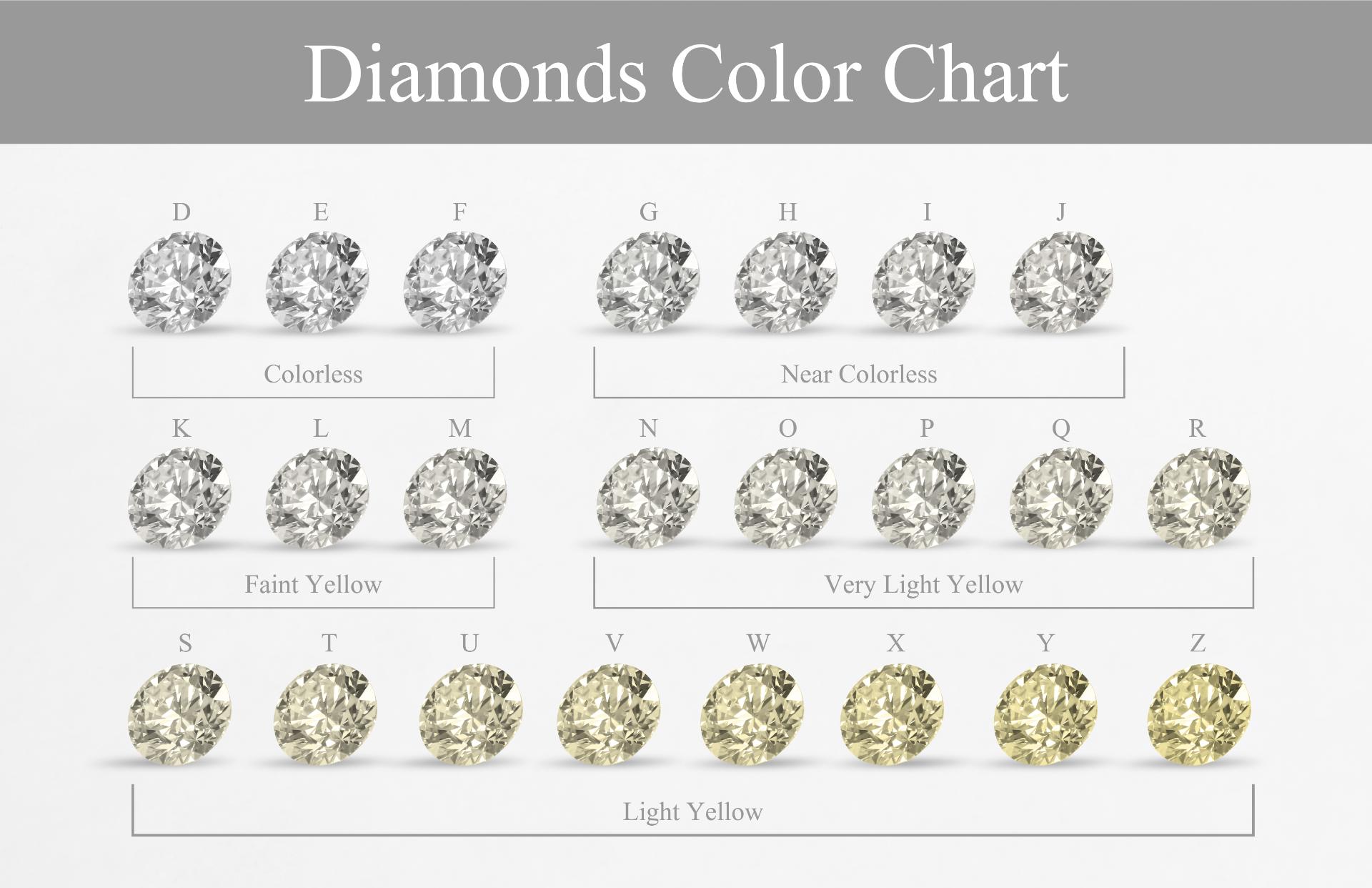
With the exception of the very rare fancy diamonds that are “other than white” in color, what most people call “white” diamonds are actually colorless diamonds. And most colorless diamonds aren’t actually colorless but have shades of yellow, gray, or brown. That’s why is created a color grading scale from D to Z , to tell people how much (or how little) color a diamond has.
Generally, preference is given to diamonds that have the least amount of color. Only D-color diamonds are completely colorless. Although, unless they’re paired with a diamond of a much higher color grade, diamonds up to the G range can’t be said to have any color. In addition to color grade, here are two other factors that affect a diamond’s color:
1. Cut: Brilliant cuts, especially round brilliants, don’t show much color, partly because they have so many facets. All the white light they are able to reflect into the stone and back out to the viewer’s eyes makes them appear brighter. Step cuts, such as emerald and asher cuts, are less brilliant because they have fewer and larger facets. Step cuts are prized more for their elegant, mirror-like effect than for their brilliance. Pears, hearts, and marquises can appear darker around the prongs because the prongs concentrate more color. Consider choosing a higher color grade if you are buying a step-cut diamond or a diamond with one or two prongs.
2. Choice: If you want a yellow or rose gold ring, save money by buying a stone that is I color or lower. Choosing a DF color diamond in a yellow or rose gold setting will make the diamond appear warmer than it actually is. If you are buying a white gold or platinum ring, consider buying a stone that is HG or higher. Choosing a stone of color grade I or lower in white gold or platinum can make the stone appear warmer, because the metal will contrast and emphasize the color of the stone. Choosing a warm stone in a yellow or rose gold setting, on the other hand, can help mask the color of the stone.
What is diamond clarity?
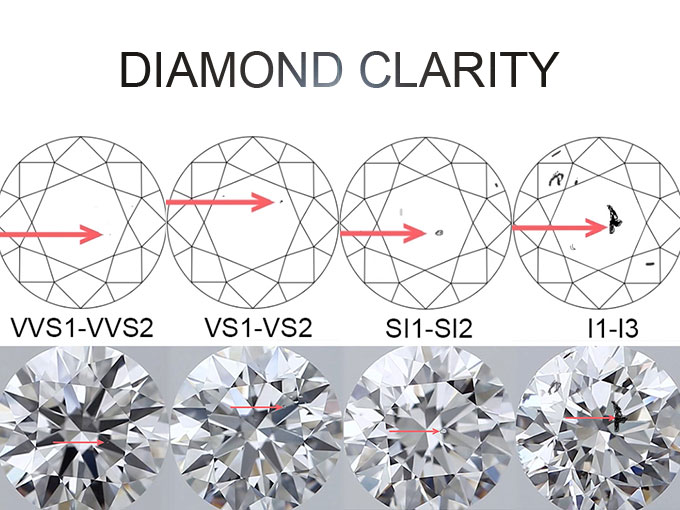
Most diamonds have inclusions from their formation process (trapped crystals, structural irregularities, etc.) that can be seen under 10X magnification. These inclusions or clarity characteristics can help identify a diamond as natural and tell scientists a lot about the Earth. But most consumers want their diamonds to be as pure as possible. That’s why is created the diamond clarity grading scale, which ranges from Flawless and Internally Flawless to Included. But even Flawless diamonds may not be completely flawless. Flawless simply means that there are no inclusions or blemishes visible under 10X magnification. Most diamonds, up to VS2 or even SI1, have no inclusions that are easily visible to the naked eye. Inclusions within an SI2 or I (Included) clarity diamond, on the other hand, will be more easily visible to the naked eye. But in general, budget-conscious consumers can save money by purchasing a comparable diamond in the VS or SI range; it will likely look similar to a diamond with a higher clarity grade to the naked eye. However, if you or the recipient of the diamond is a perfectionist, you may want to consider clarity grades VVS2 and higher, but be aware that you will also have to pay more.
Here's what to look for in a diamond with good clarity:
1. No inclusions visible to the naked eye: If you can't see any inclusions at all, or only a few inclusions that are hard to spot without magnification, the clarity is likely high enough for your jewelry purposes.
2. Location, size, and prominence of visible inclusions: Inclusions that are far from the center of the diamond are less visible. They are even less visible if they are hidden near the edge, prongs, or corners of brilliant-cut diamonds (round, marquise, pear, princess, etc.). The high number of facets on the prongs and corners of brilliant-cut stones will generally distract from minor inclusions. Inclusions near the edges may even end up being covered by the jewelry setting. Of course, smaller, lighter-colored inclusions are also harder to see and have less of an impact on the diamond’s appearance.
3. Cut Style: Inclusions are typically harder to see in brilliant-cut diamonds because they have more facets. More facets means more light bounces off, creating a complex pattern that hides small inclusions. Inclusions are much more noticeable in step-cut diamonds because they have fewer but larger facets and the resulting pattern is not as complex. Consider choosing a brilliant cut if you want to reduce clarity.
4. Durability: This is a key consideration when it comes to diamonds with lower clarity grades. Diamonds in the I clarity range, especially I2 or I3, can sometimes have durability issues. Make sure your diamond does not have large chips or fractures (feathers) on the girdle or prongs, as these can make the stone more vulnerable to breakage. Any feather that has a diamond should preferably be contained within the stone and not reach the surface.
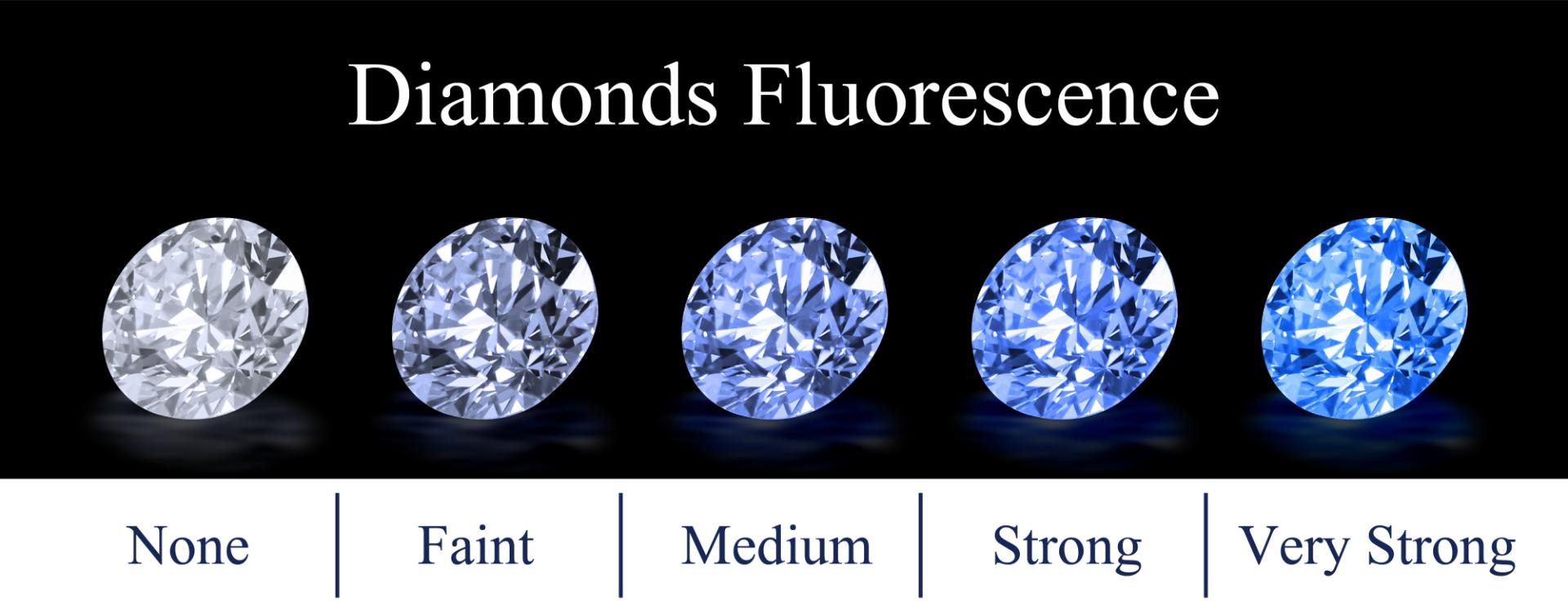
What is diamond color fluorescence?
Fluorescence is the visible light (or glow) that some diamonds emit when exposed to UV (ultraviolet) light. About a third of all diamonds have visible fluorescence. These diamonds sometimes cost slightly less, which in some ways makes them more attractive to buyers looking to save money.
Some factors to consider for fluorescent diamonds include:
1. Color grade of the diamond. Strong fluorescence can lower the value of higher color stones (DF). In rare cases, if the fluorescence is extremely strong, it can make a stone appear milky or cloudy. On the other hand, blue fluorescence can increase the value of lower color stones (I and below) because it can reduce the appearance of yellow tones in a diamond.
2. Color of the fluorescence. More than 95% of fluorescent diamonds fluoresce blue. Other colors of fluorescence include yellow, red, green, and white. Blue fluorescence can help mask warm tones in a diamond, but yellow or green fluorescence can make a diamond appear even warmer or more intense in color. Diamonds with yellow or green fluorescence typically cost less than diamonds with blue fluorescence.
3. Fluorescence Strength. If a diamond has weak to medium fluorescence, you will likely not notice that it is fluorescing in most lighting environments. Diamonds that have strong to very strong fluorescence may appear milky in sunlight, which contains UV rays. Grading reports will reveal the strength of a diamond’s fluorescence. The most surefire way to know what fluorescence looks like in a diamond, however, is to see that diamond in person under different lighting situations.
Let’s break down some common myths about fluorescence and D-to-Z color diamonds:
1. Most diamonds do not fluoresce
2. Diamonds that fluoresce only do so when exposed to invisible UV light and other higher energy radiation sources such as X-rays and laser beams. You may see your diamond fluoresce in bright sunlight, in a tanning bed, at a nightclub, or in other places where strong fluorescent or black lights are used. But once the light source is removed, the diamond will stop fluoresce.
3. Diamond fluorescence cannot always be detected. You need conditions where UV light is present and the intensity of the fluorescence is strong enough to be observed.
4. Diamonds can fluoresce in a variety of colors. These include yellow-orange, yellow, orange, red, white, and green. Variations in the atomic structure, such as the number of nitrogen atoms present, cause the phenomenon. Blue, however, is by far the most common color of diamond fluorescence.
5. Diamond fluorescence has little to no effect on the brilliance of a diamond, and research shows that it does not affect beauty either.
6. The presence or absence of fluorescence should not be used as a do-it-yourself test to determine if your diamond is real and natural.
7. You may pay higher prices for diamonds with blue fluorescence of a lower color grade because the fluorescence masks the faint to very light-yellow color in these diamonds.