No to Synthetic
The Nature of Diamond
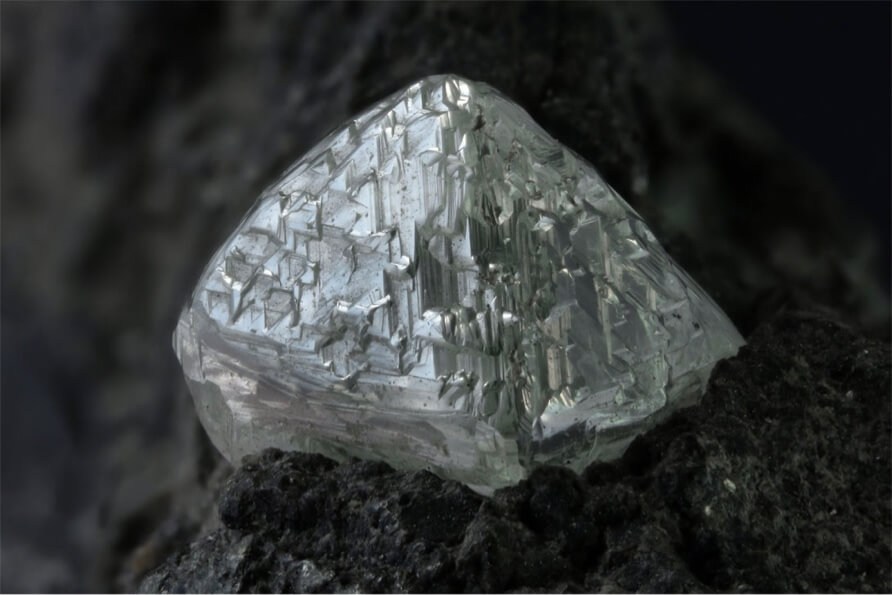
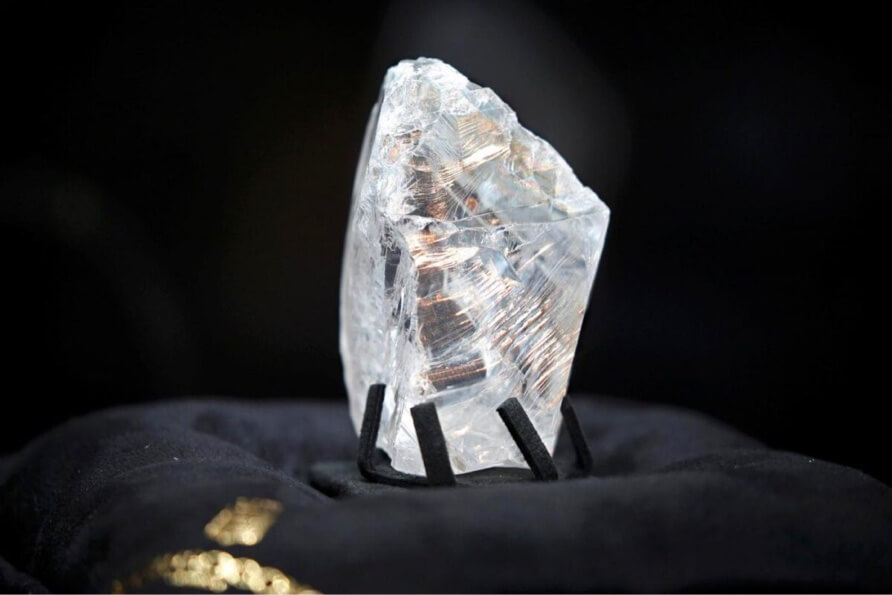
Natural diamond crystals formed millions of years ago in the earth, at a depth of about 160 km and were brought to the surface much later by volcanic explosions. These eruptions formed narrow vertical pipes of an igneous rock called kimberlite. Kimberlite pipes are mined to recover diamonds and the mineral is mechanically broken down to release the crystals.
The amount of diamond in kimberlite is very low, about one part per million, so miners have to extract large quantities of mineral to extract diamonds. Natural diamonds grow under particular conditions of pressure and temperature. The latter is much higher than that used to grow synthetic diamonds. So while at high temperatures, natural diamonds grow as octahedral crystals, synthetic diamonds obtained at lower temperatures grow as crystals with octahedral and cubic faces.
Synthetic diamonds are grown in a very short time, from several weeks to just over a month, obviously in conditions different from the formation of natural diamonds deep in the earth. Due to the very short growth period, the shape of a synthetic diamond crystal is very different from that of a natural diamond.
Synthetic Diamonds
In the mid-1950s, scientists first developed the rudiments of growing synthetic diamonds, but only produced tiny crystals.
The production of larger crystals, suitable for jewelry, began in the mid-1990s and is still evolving. Synthetic diamonds are grown in several countries around the world and are primarily used in jewelry as well as for industrial applications.
The traditional synthesis method, called High Pressure-High Temperature (HPHT) growth, synthesizes diamonds from a molten metal alloy, such as iron (Fe), nickel (Ni), or cobalt (Co). The newer method, called Chemical Vapor Deposition (CVD) or Low Pressure-High Temperature (LPHT) growth, involves forming diamonds from a gas in a vacuum chamber where the particles react with each other to create layers of carbon that gradually consolidate into a single stone. In both methods, a crystal or diamond plate is used as a seed to start the growth.
HPHT Synthesis
-
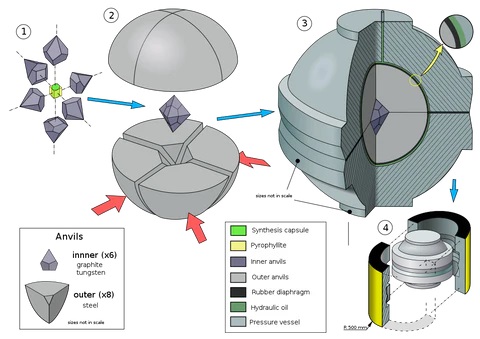
HPHT diamond growth occurs in a small capsule within an apparatus capable of generating very high pressures. Inside the capsule, the starting material, diamond powder, dissolves in the molten metal flow and then crystallizes on the seed to form the synthetic diamond crystal. Crystallization of one or a few crystals occurs over a period of a few weeks to a little over a month. HPHT synthetic diamond crystals typically exhibit cubic as well as octahedral faces. Because the crystal shapes of natural and HPHT synthetic diamonds are different, their internal growth patterns also differ significantly. These growth patterns can be one of the most reliable ways to tell them apart.
The resulting faceted synthetic gems often exhibit visual characteristics such as color distribution, fluorescence zonation, and graining patterns related to their cross-shaped growth sector structure, as well as the occasional dark metal inclusion.
In some cases, the material exhibits persistent phosphorescence after the ultraviolet lamp is turned off. These synthetic diamonds can be positively identified using laboratory techniques such as visible spectroscopy and photoluminescence. Most HPHT-grown crystals are yellow, orange-yellow, or brownish-yellow. Nearly all are Type IIb, which is rare in natural diamonds. Creating colorless HPHT synthetics has been a challenge, as modifications to growth conditions and equipment are required to exclude nitrogen. Additionally, growth rates for high-purity colorless diamonds (Type IIa or weak Type IIb) are slower than for Type Ib synthetic diamond, which requires longer growth times and greater control over temperature and pressure conditions. While it has traditionally been difficult to grow high-quality colorless HPHT crystals, recent developments have produced sufficient crystals for faceted stones over 10 carats in weight. The addition of boron to the growth system results in blue crystals. Other colors, such as pink and red, can be produced by post-growth treatment processes involving radiation and heating, but are less common.
CVD Synthesis
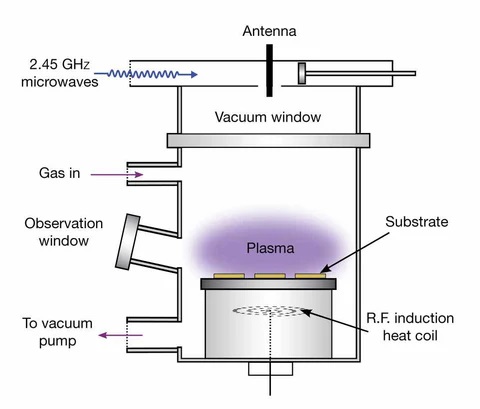
CVD diamond growth occurs inside a vacuum chamber filled with a carbon-containing gas, such as methane. An energy source, such as a microwave beam, breaks apart the gas molecules and carbon atoms are attracted down the flat diamond plates. Crystallization occurs over a period of several weeks to create a certain number of crystals; the exact number depends on the size of the chamber and the number of seedlings. Tabular crystals often have a rough, black graphite edge. They also often exhibit a brown color that can be removed by heat treatment prior to faceting. Like HPHT synthesis, CVD synthesis continues to improve and allows manufacturers to offer larger sizes and improved color and clarity.

Identification
In recent years, a growing number of companies have begun producing synthetic diamonds for jewelry use. There have been continued improvements in their clarity and color, as well as increases in carat weight.
To identify gem materials of all types, an experienced gemologist uses several types of gem testing instruments, including a refractometer, an ultraviolet fluorescence lamp, a binocular microscope, a polariscope, and additional testing instruments. As the quality of synthetic diamonds continues to improve, it is becoming increasingly difficult to separate them from natural gems using standard equipment.
Although an experienced gemologist may not be able to recognize synthetic diamonds, there are several factors that can identify a Synthetic treatment, as listed below.
These are visual characteristics of most synthetic diamonds. Not all faceted synthetic diamonds will display all of these characteristics. For example, a particular synthetic diamond may not display any fluorescence. Therefore, it is important to base the identification of the synthetic diamond on as many diagnostic characteristics as possible. HPHT-grown colored synthetic diamonds often show irregular coloration that can be seen in transmitted light using a microscope and, if necessary, by immersing the cut stone in water or mineral oil to minimize surface reflections. This color zoning is due to the way impurities, such as nitrogen, are incorporated into the forming synthetic diamond crystal. Occasionally, natural diamonds show color zoning, but not in the geometric pattern shown by HPHT synthetic diamonds.
In contrast, CVD-grown synthetic diamonds typically show uniform coloration. HPHT synthetic diamonds often show solid molten metal inclusions, which appear black and opaque in transmitted light but have a metallic luster in reflected light. Since the flux alloy used to grow diamonds usually contains elements such as iron, nickel, and cobalt, synthetic diamonds with larger metallic inclusions can be picked up with a magnet. CVD-grown synthetic diamonds form differently and have no metallic inclusions.
Some natural diamonds contain dark inclusions of graphite or some other mineral, but these inclusions do not have a metallic luster. When examined between two polarizing filters held at a 90-degree angle to each other, a natural diamond often exhibits a bright, hatched pattern or mosaic of interference or “stress” colors. These interference colors result from the diamond being subjected to stress while deep in the earth or during its explosive eruption on the earth’s surface. In contrast, synthetic diamonds grow in a nearly uniform, pressurized environment where they are not subjected to stress, so when examined in the same way, they show either no strain pattern or a faint banded strain pattern. The fluorescence of synthetic diamonds is also often very useful for identification, it is often stronger under a short-wave than under a long-wave ultraviolet lamp and may show a distinctive pattern. HPHT grown synthetic diamonds tend to display a cross-shaped fluorescence pattern on the crown or pavilion of the cut stone. CVD grown synthetic diamonds may display a striated pattern when viewed through the pavilion facets. Typical fluorescence colors are green, yellow-green, yellow, orange, or red. When the ultraviolet lamp is turned off, the synthetic diamond may exhibit persistent fluorescence for up to a minute or more.
| HPHT Synthesis | CVD Synthesis |
|---|---|
| Non-uniform color distribution | Non-uniform color distribution |
| Various graining patterns | No graining patterns |
| Unusual fluorescence colors | Unusual fluorescence colors |
| Fluorescence color patterns | Fluorescence color patterns |
| Occasional phosphorescence | Occasional phosphorescence |
| Metal flux inclusions | Occasional dark spots |
| No deformation patterns | Banded strain patterns |
| Possible girdle inscription | Possible girdle inscription |
The real identification challenge facing the jewelry trade is the testing of very small diamonds that are sold in packages of several hundred to several thousand and can include both natural and synthetic diamonds. To help the jewelry trade address this problem, there are now automated tools that have been created and developed to test even very small diamonds called DiamondView
(Synthetic Diamond Detector).
In summary, synthetic diamonds are now being made available in increasing quantities for jewelry use; we know that they can be identified with a DiamondView that tests samples of any size and color using the three basic checks of photoluminescence, ultraviolet illumination and optical absorption. The detectable characteristics can change under heat treatment (low or high pressure); these changes are identifiable and can provide unambiguous detection of CVD or HTHP grown synthetic diamonds.