Proportions and ratios of a Diamond
Diamond ratio is the ratio of the depth, width and table dimensions of the diamond.
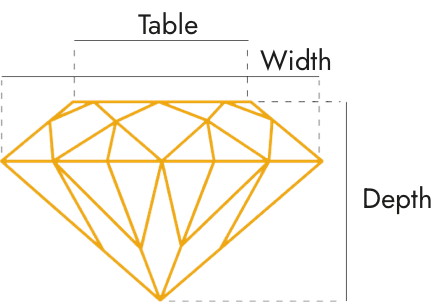
The exact proportions between the table and depth percentage play a huge role in the beauty of a diamond. The diamond's proportion is an element of the diamond's cut and is crucial to the brilliance and value of a stone.
With the perfect proportions, a diamond receives and reflects light well, resulting in brilliance and fire.
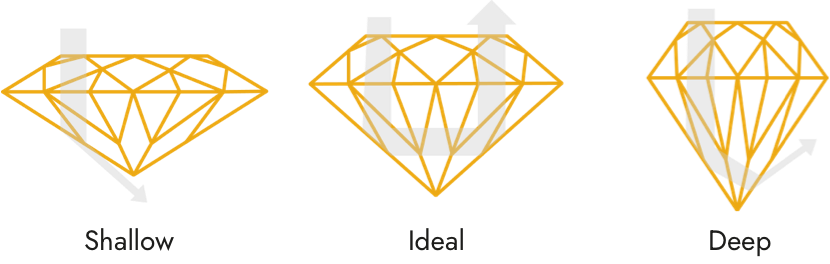
If a diamond is cut too flat or too deep, light is lost from the sides and not reflected. In other words, if a diamond's proportions are poor, the diamond appears dull and lifeless. Because a diamond with ideal cut proportions offers more brilliance, the price also tends to be higher for these diamonds, and over our years of experience, we have found that the quality of the cut is worth the extra cost, as it affects the beauty of the diamond more than any other characteristic.
How is diamond ratio calculated?
Diamond ratio is calculated using the table dimensions, crown height, and pavilion depth in relation to the diamond’s diameter. Each calculation describes the precise cut angles and ratios of the diamond. These aspects are universally measured in millimeters (mm) and/or percentages.
The Table of a Diamond
The table percentage is calculated by dividing the width of the table (top surface area) by the diameter of the diamond. For example, if the table facet is 3 mm wide and the diameter is 5 mm, the table percentage is 60%.
If the table percentage is too low, light is trapped inside the diamond and escapes from the sides of the diamond (instead of reflecting through the table). If the table percentage is too high, light does not reflect off the corners and facets of the crown, leaving the diamond dull.
Diamond Width
The width is calculated by measuring the two ends of the girdle.
The width is primarily used to determine the length-to-width ratio which denotes how proportionate the diamond is to its intended shape (i.e. rectangular vs. square). The length-to-width ratio is calculated by dividing the length of the diamond by its width. For example, if a diamond is 5 mm long and 3 mm wide, the length-to-width ratio is 1.67.
Diamond Depth
The depth percentage is calculated by dividing the diamond's depth (its height) by its width. For example, if a diamond is 3 mm deep and 4 mm wide, the depth percentage is 75%.
A diamond with a lower depth percentage usually appears larger because of its greater width, but often creates a dark appearance because the diamond does not reflect light. A diamond with too high a depth percentage will leak light to the bottom of the diamond, making it appear dull.
Factors That Affect Diamond Proportions
There are several factors that affect the proportions of a diamond, including the table size and overall depth. The way a diamond interacts with light is influenced by the size, shape, and angle of each facet.
Here are the 10 main components that affect diamond proportions:
Table Size: The length and width of a diamond's table (top surface)
Star Length: The length of the angled facets adjacent to the table
Girdle Width: The girdle height (the girdle divides the crown from the pavilion)
Lower Girdle Length: The width of the lower girdle, from the butt to where the facet connects to the girdle
Butt: The size of the diamond's butt (bottom point of a diamond)
Overall Depth: The height of a diamond from the butt to the table
Pavilion Depth: The height from the butt to the bottom of the girdle
Crown Height: The height from the top of the girdle to the table
Pavilion Angle: The angle of the pavilion from the bottom of the girdle to the edge of the diamond's pavilion
Crown Angle: The angle of the crown from the top of the girdle to the edge of the diamond's crown
Ideal Cut Diamond Proportions
The best diamond proportions allow for better light refraction. The ideal round diamond proportions are listed below and are based on expert recommendations.
Depth Percentage: 59% to 62.6%
Table Percentage: 54% to 57%
Girdle Thickness: Thin to slightly thick
Girdle: None or pointed Length to
Width Ratio: 1.00 to 1.03
Each of these factors plays a role in the beauty and brilliance of the diamond and staying within these ideal proportions will result in a stunning diamond that captures and reflects light to its fullest.
To find the best proportions in Excellent and Ideal cut diamonds, you need to check the gradings of the most serious and reliable diamond grading entities in the world that provide objective and accurate assessments of the quality of a diamond, without exaggeration or embellishment.
Below is an explanatory table that will help you in the best choice to identify the right proportions of each diamond in its different shapes.
The best diamond proportions for every shape
|
Diamond Cut |
Depth Percentage |
Table |
Percentage Girdle Thickness |
Butt |
Length to Width Ratio |
|
Round Brilliant |
(59 – 62.6) % |
(54 – 57) % |
Thin to Slightly Thick |
None or Pointed |
1.00 – 1.02 |
|
Princess |
(71 – 75) % |
(68 – 72) % |
Thin to Slightly Thick |
None or Pointed |
1.00 – 1.04 |
|
Cushion |
(67 – 70) % |
(59 – 63) % |
Thin to Slightly Thick |
None or Pointed |
1.00 – 1.08 (square) |
|
Emerald |
(66 – 69) % |
(61 – 65) % |
Thin to Slightly Thick |
None or Pointed |
1.35 – 1.50 |
|
Asscher |
(66 – 69) % |
(61 – 65) % |
Thin to Slightly Thick |
None or Pointed |
1.0 – 1.04 |
|
Oval |
(60 – 63) % |
(56 – 60) % |
Thin to Slightly Thick |
None or Pointed |
1.37 – 1.55 |
|
Pear |
(60 – 63) % |
(56 – 60) % |
Thin to Slightly Thick |
None or Pointed |
1.55 – 1.70 |
|
Radiant |
(67 – 70) % |
(64 – 68) % |
Thin to Slightly Thick |
None or Pointed |
1.00 – 1.05 (square) |
|
Heart |
(56 – 59) % |
(56 – 60) % |
Thin to Slightly Thick |
None or Pointed |
1.00 – 1.20 |
|
Marquise |
(60 – 63) % |
(56 – 60) % |
Thin to Slightly Thick |
None or Pointed |
1.90 – 2.10 |
Diamonds are known for their brilliance and each diamond sparkles under certain lighting conditions, some diamond cuts or shapes are more likely to have a pronounced and very noticeable sparkle than others. While round diamonds will have the most sparkle, other factors can make a diamond sparkle producing the most impressive sparkle, brilliance and fire.
What Makes a Diamond Sparkle?
A diamond’s sparkle depends on its ability to absorb light and then reflect it outward. The more light a diamond reflects from its facets, the more brilliant it appears.
To do this, diamonds are cut into shapes that have many facets. Each facet acts similar to a mirror, reflecting light from one part of the diamond to another and bouncing it off the diamond.
Now, it’s important to understand what “sparkle” means in this sense, as well-cut diamonds can reflect different types of light. This ability to reflect light is generally referred to as “brilliance” and “fire.”
Brilliance refers to a diamond’s ability to reflect white light. The more white light a diamond can reflect from its table, the more brilliant it is. This is what makes a diamond sparkle and look especially impressive and beautiful.
Fire refers to a diamond’s ability to disperse colored light. A diamond with great fire may emit a colorful reflection, giving it a unique character and beauty. Fire can take the form of any of the spectral colors, from red to orange, yellow, green, blue, and purple.
Most of the time, diamond cuts with more facets are more brilliant than diamond cuts with fewer facets. Some diamond cuts are specifically engineered to have the ideal number of facets for optimal light reflection and brilliance. An exquisitely cut round diamond will light up like a strobe light, however if you decide to go with an emerald cut it will still be beautiful but will not have the same brilliance as a round one.
Round Brilliant Cut
The most brilliant or sparkling cut diamond of all is the round brilliant cut. Round brilliant cut diamonds are cut to have 58 facets (including the butt) allowing light to enter the diamond and reflect off each facet to create a beautiful sparkle.
Interestingly, the round brilliant diamond cut was actually designed specifically to achieve this result. In 1919, Marcel Tolkowsky, an engineer and diamond cutter, published a new mathematical formula for achieving optimal diamond brilliance as his doctoral thesis. The formula led to the creation of the round brilliant cut, the most popular cut in the world.
Princess, Radiant, and Cushion Cuts
Princess cut
The princess cut has a great ability to cut and reflect light. In a high cut quality, a princess cut diamond can have an absolutely stunning brilliance.
Radiant Cut
The radiant cut was specially developed to combine the best aspects of the round brilliant cut and the emerald cut, with 70 facets that give it a great ability to reflect light and create a beautiful sparkle.
Cushion Cut
The cushion cut is very good at reflecting light, giving a high level of brilliance and fire to the diamond. While it is not a perfect match for the round brilliant cut, it also offers strong brilliance at a significantly lower price per carat.
Oval, Pear, Heart, and Marquise Cuts
Oval Cut
Oval diamonds, as their name suggests, are cut in an oval shape, with a similar faceted pattern to the round brilliant cut. Like the marquise, which is also an elongated shape, the oval cut is among the largest cut diamonds of the same carat weight. There are 56 facets on an oval diamond, allowing this cut to display beautiful brilliance and fire when cut well.
Pear Cut
Like the marquise and oval cuts, the pear cut (or more commonly, the teardrop) has a similar faceting to the round brilliant cut. In fact, just like the round brilliant cut, a typical pear-shaped diamond has 58 facets, which allow it to absorb and reflect an excellent amount of light. Unfortunately, many pear-shaped diamonds are poorly cut, resulting in a lack of sparkle. If you are looking for a pear-shaped diamond and want to avoid purchasing one with poor brilliance, please contact us for free assistance.
Heart Cut
Heart cut diamonds are heart-shaped, they are cut similarly to brilliant cut diamonds, with 56/58 facets. This means that when they are cut well, they can have a truly astonishing level of brilliance and fire. Like other fancy shaped diamonds, finding a well-cut heart-shaped diamond can be a challenging process. Again, if you are interested in a heart-shaped diamond and are unsure of what to look for, please do not hesitate to contact us for expert advice.
Marquis Cut
The marquis cut was developed in the 18th century when King Louis XV of France requested a diamond cut in the shape of the lips of his mistress, Madame de Pompadour, Jeanne Antoinette Poisson.
With 56 facets, the marquis cut has a similar faceting pattern to the round brilliant cut. This gives it excellent brilliance, meaning that a well-cut marquis diamond will offer great sparkle. In addition to its impressive brilliance, the marquis cut tends to appear slightly larger than other cuts of the same carat weight. This makes it a worthwhile option to consider if you want a diamond that combines beautiful sparkle with impressive presence.
Emerald and Asscher Cut
Although beautiful in their own right, the Asscher and Emerald cuts are not well known for their brilliance. Due to their design and facet patterns, diamonds in these shapes are generally not as bright and sparkling as those with a brilliant cut shape.
However, these shapes are prized for their clarity and brilliance. When cut well and with a high clarity grade, a high-quality Asscher or Emerald cut diamond can have a unique and elegant appearance.
In general, diamonds with a large number of facets like those listed above will sparkle more than diamonds with fewer facets.
However, a diamond's shape is just one of many factors that can determine how strongly it sparkles. Other factors, such as the quality of the cut, the length-to-width ratio, and the depth-to-table ratio, affect a diamond's brilliance, fire, and overall ability to sparkle.
The quality of the cut has the greatest impact on a diamond's brilliance and fire. Simply put, a well-cut diamond will reflect much more light than a poorly cut one, resulting in a much stronger and more visible sparkle. For a round brilliant cut diamond, limit your selection to “Excellent” or “Ideal”. These cut grades ensure that the diamond has the right proportions for optimal brilliance and fire. If you are considering a fancy shape diamond, we recommend using the length-to-width and depth-to-table ratio guidelines in our diamond shape guide to avoid purchasing a diamond that does not reflect light well.

It is recommended to stick to diamonds with a GIA or AGS certification
As mentioned above, it is important to stick to diamonds with a cut grade of Excellent or Ideal, these are the two most serious and reliable diamond grading entities in the world. Both provide objective and accurate assessments of a diamond’s quality, without exaggeration or embellishment.
Other grading entities are not as reliable and often give artificially high ratings that make a diamond seem better than it actually is. While these typically affect color and clarity more than cut, it is still best to stick to diamonds that come with a certificate to ensure you are truly getting what you expect.
If you are looking for the most sparkling diamond, we recommend sticking to the round brilliant cut.
Other diamond shapes also reflect a lot of light, such as marquise, oval, pear, and heart cuts, and can sparkle beautifully. Princess, radiant, and cushion cuts also look great when cut to a high standard and are all great choices.
That said, there’s more to a diamond’s sparkle than just its shape. Look for a diamond that has a cut grade of Ideal or Excellent, as it’s more likely to reflect light and produce beautiful brilliance.